
Good, bad, well, badly · Spanish A2
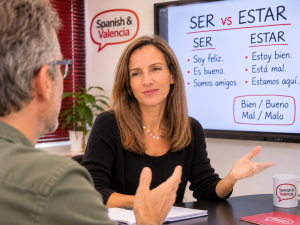
1. When do we use SER and ESTAR?
First, remember this idea:
- SER: identifies or describes the characteristics of a person, thing or situation.
- ESTAR: expresses states, conditions or how we feel.
2. SER + BUENO / MALO
We use SER + BUENO/A/S and MALO/A/S to talk about characteristics, qualities or opinions.
| Expression | Meaning | Example |
|---|---|---|
| Ser bueno | To have good qualities | María es buena persona. (María is a good person.) |
| Ser malo | To have bad qualities | Ese hombre es malo. (That man is bad.) |
| Ser bueno | To be of good quality | Este restaurante es muy bueno. (This restaurant is very good.) |
| Ser malo | To be of poor quality | Este libro es malo. (This book is bad.) |
We can also talk about skills:
- Juan es bueno en matemáticas. (Juan is good at maths.)
- Mi hermana es buena cocinera. (My sister is a good cook.)
- Soy malo jugando al fútbol. (I am bad at playing football.)
3. ESTAR + BIEN / MAL
We use ESTAR + BIEN / MAL to express states, situations or results.
| Expression | Meaning | Example |
|---|---|---|
| Estar bien | To feel well | Hoy estoy bien. (Today I am fine.) |
| Estar mal | To feel unwell | Mi padre está mal. (My father is not well.) |
| Estar bien | To be correct | Tu respuesta está bien. (Your answer is correct.) |
| Estar mal | To be incorrect | Este ejercicio está mal. (This exercise is wrong.) |
More examples:
- ¿Cómo estás? Estoy bien, gracias. (How are you? I am fine, thanks.)
- ¿Qué tal el examen? Creo que está bien. (How was the exam? I think it is fine.)
- No estoy bien, tengo dolor de cabeza. (I am not well, I have a headache.)
- Tu habitación está muy bien organizada. (Your room is very well organised.)
We never say “es bien” or “es mal”. Bien and mal are adverbs: they are not used with SER. We say es bueno / es malo (SER) or está bien / está mal (ESTAR). With other verbs: Hablas bien. Cantan mal. (You speak well. They sing badly.)
4. Careful! SER BUENO ≠ ESTAR BUENO
This difference is very important.
|
SER BUENO/A
It has good qualities.
|
ESTAR BUENO/A
It tastes good, or someone looks physically attractive.
|
|
SER MALO/A
It has bad qualities or poor quality.
|
ESTAR MALO/A
Someone is ill, or something has gone off.
|
5. Now practise!
There are 5 activities (24 questions). Click an answer to see straight away if it is correct. Each correct answer is +1 point.
Activity 1 · SER or ESTAR?
Choose the correct form of the verb.
1. Marta ___ una buena amiga.
es
✔ Correct! +1 point. Quality of a person → SER.
está
✘ Not quite. The correct answer is: es. Quality of a person → SER.
2. Hoy mi madre ___ mal. Tiene fiebre.
es
✘ Not quite. The correct answer is: está. How someone feels now → ESTAR.
está
✔ Correct! +1 point. How someone feels now → ESTAR.
3. Esta película ___ muy mala.
es
✔ Correct! +1 point. Poor quality → SER.
está
✘ Not quite. The correct answer is: es. Poor quality → SER.
4. La leche ___ mala. Huele fatal.
es
✘ Not quite. The correct answer is: está. Condition of food (it has gone off) → ESTAR.
está
✔ Correct! +1 point. Condition of food (it has gone off) → ESTAR.
5. Ese chico ___ malo. Siempre miente.
es
✔ Correct! +1 point. Characteristic of a person → SER (he is not a good person).
está
✘ Not quite. The correct answer is: es. Characteristic of a person → SER (he is not a good person).
6. Mi abuela ___ mala. Tiene gripe.
es
✘ Not quite. The correct answer is: está. State of health → ESTAR (she is ill, not a bad person).
está
✔ Correct! +1 point. State of health → ESTAR (she is ill, not a bad person).
7. Acabo de probar esta pizza: ¡___ buenísima!
es
✘ Not quite. The correct answer is: está. Taste → ESTAR + bueno.
está
✔ Correct! +1 point. Taste → ESTAR + bueno.
Activity 2 · bien, bueno, buen, buena
Pick the correct word from three options.
1. Mi hermano canta muy ___.
bien
✔ Correct! +1 point. It describes the verb cantar → adverb BIEN.
bueno
✘ Not quite. The correct answer is: bien. It describes the verb cantar → adverb BIEN.
buen
✘ Not quite. The correct answer is: bien. It describes the verb cantar → adverb BIEN.
2. Es un ___ restaurante.
bien
✘ Not quite. The correct answer is: buen. Before a masculine singular noun, bueno becomes BUEN.
buen
✔ Correct! +1 point. Before a masculine singular noun, bueno becomes BUEN.
bueno
✘ Not quite. The correct answer is: buen. Before a masculine singular noun, bueno becomes BUEN.
3. Tus amigas son muy ___.
buenas
✔ Correct! +1 point. Adjectives agree: amigas is feminine plural → BUENAS.
buenos
✘ Not quite. The correct answer is: buenas. Adjectives agree: amigas is feminine plural → BUENAS.
bien
✘ Not quite. The correct answer is: buenas. Adjectives agree: amigas is feminine plural → BUENAS.
4. Hoy no estoy ___. Me duele la cabeza.
bueno
✘ Not quite. The correct answer is: bien. How I feel → estoy BIEN.
bien
✔ Correct! +1 point. How I feel → estoy BIEN.
buen
✘ Not quite. The correct answer is: bien. How I feel → estoy BIEN.
Activity 3 · Complete the conversation
Choose the word or verb that completes each mini-dialogue.
1. — ¿Cómo estás? — Estoy ___, gracias.
bien
✔ Correct! +1 point. Answer to “¿Cómo estás?” → estoy BIEN.
bueno
✘ Not quite. The correct answer is: bien. Answer to “¿Cómo estás?” → estoy BIEN.
buena
✘ Not quite. The correct answer is: bien. Answer to “¿Cómo estás?” → estoy BIEN.
2. — ¿Qué tal la paella? — ¡Está muy ___!
bueno
✘ Not quite. The correct answer is: buena. Taste of food; paella is feminine → BUENA.
bien
✘ Not quite. The correct answer is: buena. Taste of food; paella is feminine → BUENA.
buena
✔ Correct! +1 point. Taste of food; paella is feminine → BUENA.
3. — ¿Cómo es tu jefe? — ___ una persona muy buena.
Es
✔ Correct! +1 point. “¿Cómo es…?” asks what someone is like → SER (es).
Está
✘ Not quite. The correct answer is: Es. “¿Cómo es…?” asks what someone is like → SER (es).
Estoy
✘ Not quite. The correct answer is: Es. “¿Cómo es…?” asks what someone is like → SER (es).
4. — ¿Puedo cerrar la ventana? — Sí, ___ bien.
es
✘ Not quite. The correct answer is: está. “Está bien” = it is OK → ESTAR.
está
✔ Correct! +1 point. “Está bien” = it is OK → ESTAR.
estoy
✘ Not quite. The correct answer is: está. “Está bien” = it is OK → ESTAR.
Activity 4 · Find the mistake
Only one sentence is correct. Click it.
1. Which sentence is correct?
Mi hijo es mal hoy.
✘ Not quite. The correct answer is: Mi hijo está mal hoy.. How he feels today → ESTAR + mal.
Mi hijo está mal hoy.
✔ Correct! +1 point. How he feels today → ESTAR + mal.
2. Which sentence is correct?
Es una buena idea.
✔ Correct! +1 point. Before a noun we need the adjective buena, not the adverb bien.
Es una bien idea.
✘ Not quite. The correct answer is: Es una buena idea.. Before a noun we need the adjective buena, not the adverb bien.
3. Which sentence is correct?
Ellas cantan bueno.
✘ Not quite. The correct answer is: Ellas cantan bien.. After a verb we use the adverb BIEN.
Ellas cantan bien.
✔ Correct! +1 point. After a verb we use the adverb BIEN.
4. Which sentence is correct?
Es un mal día.
✔ Correct! +1 point. Before a masculine singular noun, malo becomes MAL.
Es un malo día.
✘ Not quite. The correct answer is: Es un mal día.. Before a masculine singular noun, malo becomes MAL.
5. Which sentence is correct?
Es bien así.
✘ Not quite. The correct answer is: Está bien así.. We never say “es bien”. “Está bien” = it is OK → ESTAR.
Está bien así.
✔ Correct! +1 point. We never say “es bien”. “Está bien” = it is OK → ESTAR.
Activity 5 · English to Spanish
Choose the correct Spanish translation.
1. My sister is a good doctor.
Mi hermana es una buena doctora.
✔ Correct! +1 point. Doctora is feminine → BUENA (buen is only for masculine nouns).
Mi hermana es una buen doctora.
✘ Not quite. The correct answer is: Mi hermana es una buena doctora.. Doctora is feminine → BUENA (buen is only for masculine nouns).
2. I am not well today.
No estoy bien hoy.
✔ Correct! +1 point. How I feel now → ESTAR + bien.
No soy bien hoy.
✘ Not quite. The correct answer is: No estoy bien hoy.. How I feel now → ESTAR + bien.
3. The coffee is bad today (it tastes bad).
El café está malo hoy.
✔ Correct! +1 point. Café is masculine → MALO. Taste now → ESTAR.
El café está mala hoy.
✘ Not quite. The correct answer is: El café está malo hoy.. Café is masculine → MALO. Taste now → ESTAR.
4. They are very good students.
Son muy buenos estudiantes.
✔ Correct! +1 point. Plural noun → BUENOS (buen is only singular).
Son muy buen estudiantes.
✘ Not quite. The correct answer is: Son muy buenos estudiantes.. Plural noun → BUENOS (buen is only singular).
6. Your score
Add up your ✔ points (maximum 24) and click your range:
22 – 24 points
Excellent! You use SER / ESTAR with bien, bueno, mal and malo very well.
16 – 21 points
Good job! Review SER BUENO vs ESTAR BUENO and try again.
0 – 15 points
Keep practising! Read the explanation again and repeat the activities.